
Connecting Care with Compliance: Why GRC Matters in Healthcare
Updated: Dec 4, 2025
In the high-stakes world of emergency healthcare, every second counts. But while medical teams race to save lives, there's an equally critical framework operating behind the scenes: Governance, Risk, and Compliance (GRC). Far from being bureaucratic red tape, GRC serves as the backbone that enables emergency departments to deliver exceptional care while protecting patients, staff, and the organization itself.
The Critical Intersection of Care and Compliance
Emergency healthcare operates at the intersection of urgency and complexity. Patients arrive in crisis, decisions must be made rapidly, and the margin for error is razor-thin. In this environment, GRC isn't just about checking boxes—it's about creating systems that support clinical excellence while managing the inherent risks of emergency medicine.
When properly implemented, GRC frameworks ensure that compliance requirements enhance rather than hinder patient care. They provide clear protocols for medication administration, establish secure handling of patient information, and create accountability structures that protect both patients and providers.
Understanding the Three Pillars in Emergency Settings
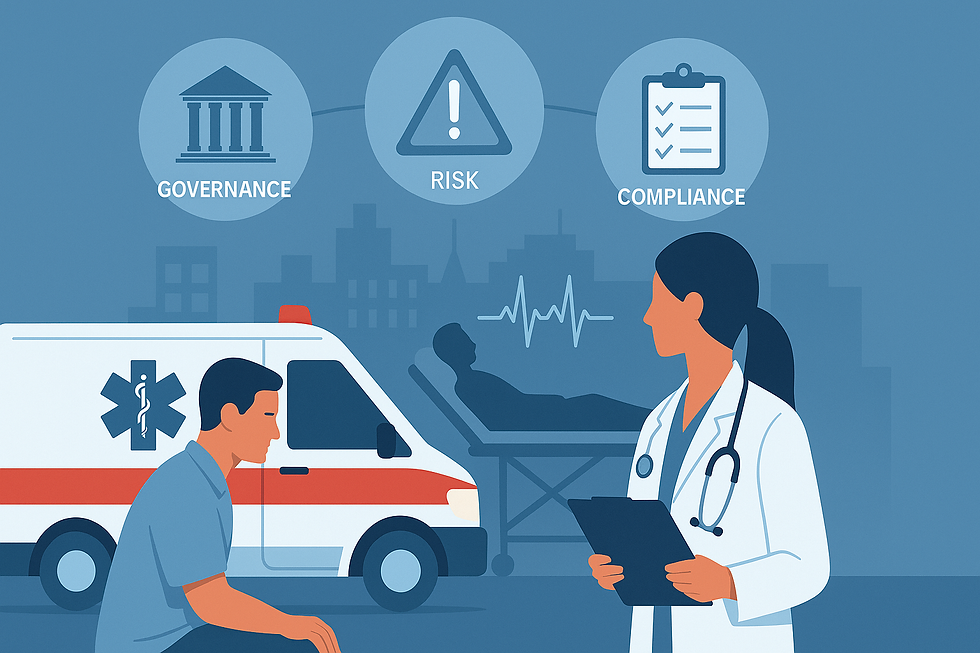
Governance in emergency healthcare establishes the decision-making structures and accountability frameworks that guide operations. This includes defining roles during mass casualty events, establishing escalation protocols for critical decisions, and ensuring that leadership has real-time visibility into department performance and safety metrics.
Risk Management identifies and mitigates the unique hazards emergency departments face: from medication errors during high-pressure resuscitations to data breaches involving sensitive patient information. Effective risk management in emergency settings means anticipating what could go wrong before it does, whether that's inadequate staffing during peak hours or insufficient backup systems during power outages.
Compliance ensures that emergency departments meet the complex web of regulatory requirements, from HIPAA privacy rules to EMTALA patient screening obligations, from CMS conditions of participation to state-specific emergency care mandates. In emergency settings, compliance must be designed to work at the speed of care.
Real-World Impact: Where GRC Saves Lives
Consider a typical emergency department scenario: A patient arrives unconscious with unknown allergies. The GRC framework ensures that:
Governance structures have established clear protocols for treating patients without complete histories
Risk management systems have implemented fail-safes for allergy checking and medication verification
Compliance measures ensure proper documentation occurs even in crisis situations, protecting the patient's legal rights and the provider's liability
Without these frameworks, each emergency becomes an improvisation. With them, teams can focus on clinical care while the system handles the guardrails.
Building a Culture of Integrated Compliance
The most successful emergency departments don't treat GRC as separate from clinical care, they integrate it seamlessly. This means:
Training that Connects: Staff education that links compliance requirements to patient safety outcomes, helping teams understand the "why" behind the rules.
Technology that Enables: Electronic health records and clinical systems designed with compliance built in, not bolted on, allowing providers to deliver care without administrative friction.
Leadership that Prioritizes: Executive teams that invest in GRC infrastructure and recognize that compliance failures often represent system failures, not individual shortcomings.
Continuous Improvement: Regular audits, incident reviews, and process refinements that treat every near-miss as an opportunity to strengthen both care and compliance.
The Path Forward
As healthcare becomes increasingly complex, the role of GRC in emergency settings will only grow. Emerging technologies like AI-assisted triage and telemedicine consultations bring new capabilities, and new compliance considerations. Evolving threats like ransomware attacks and data breaches require sophisticated risk management responses.
Emergency healthcare leaders who embrace GRC as a strategic priority position their departments for excellence. They create environments where clinicians can practice at the top of their license, where patients receive care that is both excellent and safe, and where the organization is protected against the myriad risks inherent in emergency medicine.
Conclusion
In emergency healthcare, connecting care with compliance isn't optional, it's essential. GRC frameworks provide the structure that allows emergency departments to deliver lifesaving care consistently, safely, and in accordance with regulatory requirements. When viewed not as a burden but as a foundation for excellence, GRC becomes what it should be: an enabler of the mission to provide exceptional emergency care to every patient, every time.


Comments